
Table of Contents
-
Best LED Light Bars for Trail: Top 10 Picks
- 1. Baja Designs OnX6+ LED Light Bar
- 2. KC HiLiTES Gravity LED Pro6 Light Bar
- 3. Rough Country Black Series LED Light Bar
- 4. Nilight Triple Row Spot Flood Combo LED Light Bar
- 5. Auxbeam 6 Modes Series White & Amber LED Light Bar
- 6. PIAA RF Series LED Light Bar
- 7. Extreme LED X6S Slim Amber & White LED Light Bar
- 8. Hella ValueFit Design Light Bars
- 9. Auxbeam V-Series RGB Color Changing LED Light Bar
- 10. Precision Upgrades Premium LED Lighting
- Quick Comparison Table: LED Light Bars for Trail Use
- LED Light Bar Beam Patterns Explained
- Durability and Weather Resistance: What Ratings Mean
- LED Light Bar Installation for Off-Road Vehicles
- Waterproof LED Light Bars: Moisture Protection That Works
- Off-Road Lighting Laws and Street-Legal Compliance
- How to Choose the Right LED Light Bar for Your Trail Adventures
Best LED Light Bars for Trail: Top 10 for 2026
Last Updated: July 29, 2026
When navigating backcountry trails after dark, visibility becomes a safety issue. The best LED light bars for trail use combine extreme brightness with durability that withstands vibration, moisture, and temperature swings. At Precision Upgrades, we've tested dozens of options across real trail conditions. This guide covers the top 10 LED light bars for 2026, comparing beam patterns, durability ratings, installation complexity, and real-world performance.
Quick Comparison Table: LED Light Bars for Trail Use
| Model | Starting Price | Beam Pattern | Waterproof Rating | Best For |
|---|---|---|---|---|
| Baja Designs OnX6+ | $442.95 | Spot | IP67 | Long-distance projection and extreme durability |
| KC HiLiTES Gravity LED Pro6 | $1,614.99 | Modular (Spot/Driving/Wide) | IP67 | Customizable beam configurations |
| Rough Country Black Series | $69.95 | Combo | IP67 | Budget-conscious off-roaders |
| Nilight Triple Row | $49.99 | Spot/Flood combo | IP67 | High lumen output on a tight budget |
| Auxbeam 6 Modes Series | $59.99 | Combo | IP67 | Switching between white and amber light |
| PIAA RF Series | $304.99 | Driving/Fog | IP67 | Precise beam control and fog penetration |
| Extreme LED X6S Slim | $89.99 | Amber/White combo | IP67 | Slim profile with dual-color functionality |
| Hella ValueFit Design | $50.82 | Combo | IP67 | Balanced performance at entry-level price |
| Auxbeam V-Series RGB | $105.99 | Combo | IP67 | Customizable RGB colors with white light |
| Precision Upgrades Premium LED | Contact for pricing | Spot/Flood/Combo | IP69K | Premium overlanding gear with fast shipping |
1. Baja Designs OnX6+ LED Light Bar
The Baja Designs OnX6+ sets the standard for serious trail runners. Its High Speed Spot reflector projects light 200+ feet ahead, ideal for high-speed desert racing or technical rock crawling. The MoistureBlock waterproof design and replaceable lenses allow field repairs without replacing the entire unit. Aircraft-grade aluminum with Mil-Spec hard anodize finish survives impacts that destroy lesser bars. The 5000K daylight color temperature reduces driver fatigue during extended night runs.
Pros: Industry-leading light projection, modular design, extremely durable construction
Cons: Higher price point, wiring harness sold separately
2. KC HiLiTES Gravity LED Pro6 Light Bar
The KC HiLiTES Gravity LED Pro6 offers flexibility to swap beam patterns without buying multiple light bars. Its patented Infinity Ring system converts straight beams to radius configurations, and modular Gravity G6 optical inserts change from spot to driving to wide-40 beam patterns. This adaptability matters when trail conditions change mid-trip. The system delivers exceptional light output with remarkably low amperage draw, critical if your truck's alternator is already stressed by winches and compressors.
Pros: Highly adaptable beam patterns, race-proven durability, exceptional light output with low electrical draw
Cons: Premium pricing, higher installation complexity
3. Rough Country Black Series LED Light Bar
The Rough Country Black Series delivers solid performance without premium pricing. High-intensity CREE LEDs produce brightness comparable to bars costing three times as much. IP67 waterproof rating and Moisture Breather technology prevent condensation buildup that kills cheaper bars after 12-18 months. The included wiring harness with on-off switch eliminates compatibility hunting. Die-cast aluminum housing dissipates heat effectively, keeping LEDs at peak brightness during sustained night driving.
Pros: Affordable price, reliable performance, includes wiring harness
Cons: Advanced optics don't match higher-end brands, shorter 3-year warranty
4. Nilight Triple Row Spot Flood Combo LED Light Bar
The Nilight Triple Row delivers extreme brightness in a spot and flood combo configuration. At $49.99 for a 20-inch bar with mounting brackets and harness kit included, it's one of the few complete systems requiring no additional purchases. The combo beam pattern adapts to mixed terrain, and the 6063 aluminum profile housing handles heat dissipation effectively.
Pros: Very high lumen output for the price, combo beam provides distance and spread, sold as complete kits
Cons: 30,000-hour lifespan is lower than premium brands
5. Auxbeam 6 Modes Series White & Amber LED Light Bar
The Auxbeam 6 Modes Series solves visibility in dust, fog, and snow. White and amber light combinations let you switch modes based on conditions. Amber light cuts through dust clouds better than white, reducing glare when visibility is compromised. Available in multiple lengths, it adapts to different vehicle sizes with a combo beam pattern balancing spot and flood coverage.
Pros: Versatile white and amber light modes, affordable pricing, effective in adverse weather
Cons: Brightness may not match premium brands
6. PIAA RF Series LED Light Bar
The PIAA RF Series uses Reflector Facing Technology (RFT) to create precise beam control. The computer-designed multi-surface reflector produces a sharp cutoff line, important in light-pollution-regulated areas. Driving and fog beam options provide versatility. Cast aluminum housing and polycarbonate lenses withstand impacts. PIAA includes mounting brackets and wiring harness.
Pros: Superior beam control, effective in adverse weather, durable compact design
Cons: More expensive than entry-level options, limited beam patterns
7. Extreme LED X6S Slim Amber & White LED Light Bar
The Extreme LED X6S Slim prioritizes a narrow profile for vehicles with tight mounting space. The slim design fits between cab and roof without bulk. Amber and white LED options adapt to conditions, and the lifetime warranty signals confidence. Wiring harness is included.
Pros: Dual amber and white functionality, slim profile, lifetime warranty
Cons: Specific lumen output not always prominently displayed
8. Hella ValueFit Design Light Bars
Hella brings automotive lighting heritage to off-road applications. The ValueFit Design combines spot and flood patterns with inner spots and outer flood elements. Die-cast aluminum body and aluminum alloy brackets provide durability at entry-level pricing, available in multiple sizes for different vehicle configurations.
Pros: Reputable brand, good balance of spot and flood illumination, durable construction
Cons: Lower lumen output compared to specialized bars
9. Auxbeam V-Series RGB Color Changing LED Light Bar
The Auxbeam V-Series RGB offers customizable lighting beyond pure function. RGB color-changing capabilities let you switch between white light for trails and colored light for camp. Available in straight and curved designs, this bar balances aesthetics with white light functionality.
Pros: Customizable RGB lighting, offers white and colored light options, affordable
Cons: Primary focus may be on aesthetics over raw light output
10. Precision Upgrades Premium LED Lighting
Precision Upgrades delivers premium overlanding gear built for trucks, SUVs, and motorcycles demanding reliability on extended expeditions. Our LED lighting combines high-performance CREE and OSRAM LED technology with IP69K waterproof ratings that exceed standard IP67 requirements, providing submersion resistance and sustained high-pressure water spray protection. Replaceable lens assemblies and modular heat sink designs mean you're not replacing entire light bars when one component fails. Fast shipping gets your gear before your trip, and our community provides real-world feedback on durability across varied trail conditions. The 15% discount for newsletter subscribers applies to your first order.
Pros: Premium overlanding gear, IP69K waterproof rating, modular design enables field repairs, fast shipping
Cons: Premium pricing, contact for specific pricing
LED Light Bar Beam Patterns Explained
Beam pattern determines how light distributes across terrain. A spot beam throws light far but covers narrow ground area. A flood beam spreads light wide but doesn't reach far. A combo beam combines both.
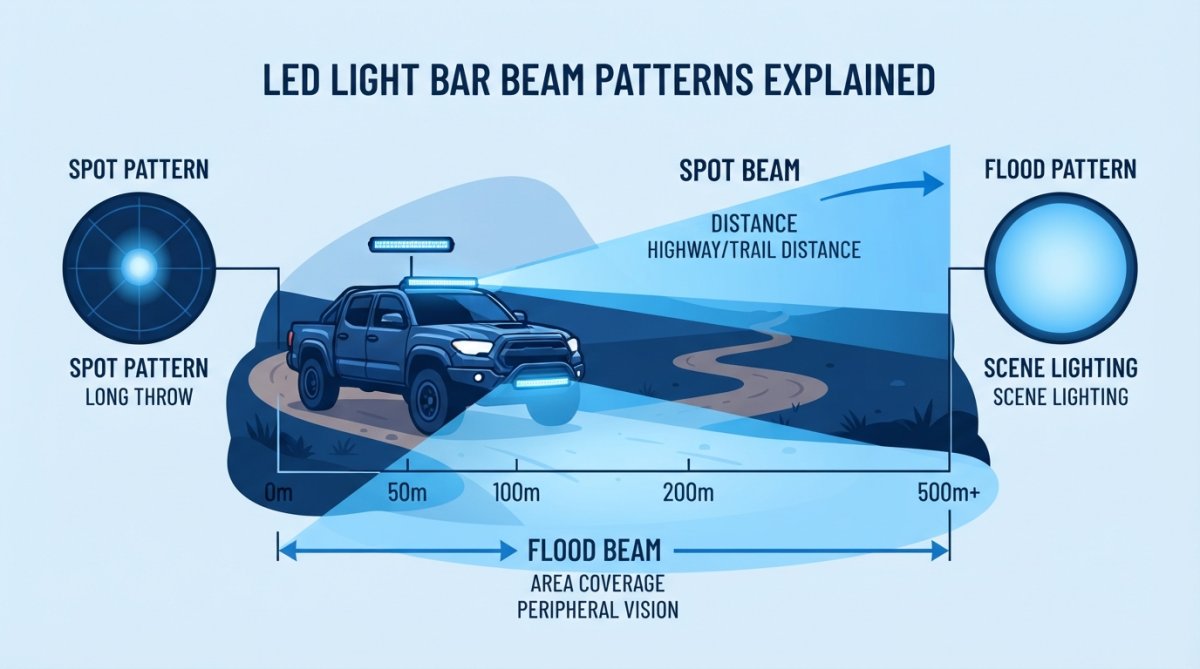
Spot Beam vs. Flood Beam vs. Combo
Spot beam concentrates light into a tight column projecting 300+ feet ahead, suiting high-speed desert running. Terrain immediately in front gets less light.
Flood beam spreads light wide across 120-180 degrees, illuminating close-range terrain thoroughly. Rock crawling benefits from flood patterns for assessing immediate line choices.
Combo beam uses multiple LED elements to create both patterns simultaneously. Inner elements focus as spot; outer elements spread as flood. This hybrid works well for overlanding where terrain varies.
Desert racers choose pure spot. Rock crawlers choose pure flood. Overlanders choose combo.
Durability and Weather Resistance: What Ratings Mean
IP ratings measure dust and water protection. Understanding these numbers prevents buying a bar that fails after the first heavy rain.
IP67 vs. IP69K Waterproof Ratings
IP67 means dust-tight and protected against temporary immersion up to 1 meter for 30 minutes. Most quality LED bars meet this standard, handling river crossings, sustained rain, and mud spray. High-pressure water jets can force moisture past seals.
IP69K adds protection against high-pressure, high-temperature water jets. This rating matters for deep water crossings, pressure washing, or sustained water spray environments. The difference is breather technology. IP67 bars have sealed designs that trap moisture. IP69K designs include breather valves that equalize pressure while filtering air, preventing condensation buildup.
Heat Sink Technology and CREE vs. OSRAM LEDs
LED brightness depends on heat management. Premium bars use aluminum heat sinks with large surface areas and sometimes copper cores for superior thermal conductivity.
CREE LEDs dominate the off-road lighting market. They're efficient, reliable, and produce excellent color temperature (5000-6500K daylight). CREE technology is proven across thousands of trail-tested bars.
OSRAM LEDs offer comparable performance with slightly different color characteristics. The real difference is the heat sink design surrounding the LED. Budget bars skimp on heat sink material, causing LEDs to dim over time. Premium bars invest in oversized aluminum housings that maintain brightness across thousands of hours.
LED Light Bar Installation for Off-Road Vehicles
Installation difficulty ranges from simple (bolt to existing roof rack) to complex (requires custom wiring and reinforced mounts).
Mounting Locations and Hardware Options
Roof mounting is most common. Existing roof racks or custom brackets secure the bar above the cab, providing optimal beam throw.
Bumper mounting places the bar lower, integrated into front or rear bumper designs. This reduces height but limits beam throw distance.
A-pillar mounting attaches bars to the roof edge near the windshield, providing good visibility angles while maintaining lower profile.
Modular bracket systems allow repositioning without permanent installation, helping if testing placement or using the bar across multiple vehicles.
Hardware matters. Stainless steel bolts resist corrosion. Vibration-resistant washers prevent loosening from trail impacts. Quality bars include appropriate hardware.
Electrical System Load and Wiring Harness Setup
An LED light bar draws significant amperage. A typical 40-inch bar with 240W power consumption draws 20 amps at 12V. If your vehicle's alternator is already powering a winch, compressor, and auxiliary fridge, adding 20 amps can exceed available capacity.
Calculate your electrical load:
- Stock alternator output: typically 100-130 amps
- Essential vehicle systems: 50-70 amps
- Remaining available capacity: 30-60 amps
- Your light bar draw: check specifications
If your light bar exceeds available capacity, your battery drains during operation. Upgrade to a higher-output alternator (150-200 amps) if needed.
Wiring harness setup requires heavy-gauge wire (4-6 gauge) from battery to light bar, an inline fuse within 18 inches of battery, a relay to handle switching, and a ground wire to vehicle frame. Quality harnesses from Baja Designs, KC HiLiTES, and Precision Upgrades include properly sized components.
Waterproof LED Light Bars: Moisture Protection That Works
Moisture inside a light bar causes corrosion and condensation on the lens that reduces light output.
How MoistureBlock and Breather Technology Prevent Failure
Sealed design (older approach): Completely sealed housings trap air inside. Temperature changes create pressure differences that force moisture past seals. After 18-24 months, internal corrosion becomes visible.
Breather technology (modern approach): Small vents with hydrophobic membranes allow pressure equalization while blocking liquid water. This prevents condensation buildup and extends lifespan to 5+ years.
Baja Designs MoistureBlock technology uses breather membranes rated to withstand mud, dust, and salt spray. The membranes are replaceable. Breather technology wins for trail reliability.
Off-Road Lighting Laws and Street-Legal Compliance
LED light bar regulations vary by state. Understanding legal restrictions prevents costly fines.
Legal Restrictions by State and Auxiliary Light Rules
Federal regulations (DOT/FMVSS standards) prohibit auxiliary lights from being the primary forward lighting. LED light bars are supplemental.
State variations:
- California restricts auxiliary lights to amber (side/rear) or white (roof). Forward-facing white bars are legal if mounted above the windshield and aimed downward.
- Texas allows auxiliary lights with minimal restrictions.
- New York prohibits white auxiliary lights entirely. Amber only.
- Colorado allows roof-mounted white lights but restricts bumper-mounted bars.
Street-legal installation requires lights aimed downward, proper switches, compliance with local height restrictions, and proper registration if modifying vehicle lighting.
How to Choose the Right LED Light Bar for Your Trail Adventures
Selecting the right light bar depends on your specific trail use, electrical capacity, and budget.
Lumen Output, Beam Throw, and Night Visibility Needs
Lumen output measures total light brightness. Typical off-road bars range from 5,000 to 50,000 lumens.
For practical trail use:
- Rock crawling: 10,000-20,000 lumens with flood pattern
- Trail riding: 20,000-30,000 lumens with combo pattern
- Desert racing: 30,000-50,000 lumens with spot pattern
Beam throw measures how far light projects. A 300-foot throw lets you see obstacles at highway speeds. A 100-foot throw works for technical terrain.
Budget, Warranty, and Repairability Considerations
Entry-level ($50-150): Adequate for casual trail use. Expect 2-3 year lifespan. Warranty typically 1-2 years.
Mid-range ($200-500): Good balance of brightness, durability, and cost. 4-5 year lifespan. Warranty typically 3 years.
Premium ($600+): Maximum brightness and durability. 7+ year lifespan. Warranty 5+ years. Modular design enables repairs.
Repairability matters on extended expeditions. Bars with replaceable lenses, heat sinks, and optical elements can be field-repaired. Sealed units require complete replacement if one component fails.
Frequently Asked Questions
What are the brightest LED light bars for off-road trail use?
The brightest LED light bars for trail riding combine high lumen output with efficient reflector design. The Baja Designs OnX6+ and KC HiLiTES Gravity LED Pro6 are industry leaders, offering superior beam throw and brightness for serious off-road adventures. Lumen output alone doesn't guarantee visibility, beam pattern, reflector quality, and LED type (CREE vs. OSRAM) all affect real-world performance on trails. Look for models with 40,000+ lumens and spot-focused beam patterns for maximum distance projection.
How do LED light bar beam patterns affect trail visibility?
Beam patterns directly impact what you see on the trail. Spot beams project light 200+ feet ahead for high-speed riding, flood beams illuminate close terrain and obstacles, and combo beams balance both. For technical trail riding, combo patterns work best, they provide distance visibility plus peripheral awareness. Spot-only bars suit fast desert or open trail riding. Understanding beam patterns prevents buying a light bar that doesn't match your trail style or vehicle speed.
Are LED light bars legal for on-road use in the United States?
LED light bar legality varies by state. Most states restrict auxiliary lights, they're generally illegal as primary headlights on public roads but allowed as supplemental off-road lighting. Some states require lights to be covered or disabled when driving on-road. Federal regulations (FMVSS standards) govern vehicle lighting, and many aftermarket LED bars don't meet street-legal specifications. Always check your state's DMV regulations before installing. Off-road-only use on private property avoids legal complications entirely.
What waterproof rating do I need for a durable LED light bar?
IP67 is the minimum for serious trail use, it means dust-proof and submersible to 1 meter. IP69K offers superior protection against high-pressure water jets and is ideal for extreme conditions, rock crawling, or water crossings. Many premium brands like Baja Designs use MoistureBlock technology with replaceable lenses to prevent internal condensation. Check the wiring harness rating too, a waterproof light bar with a poor harness connection will fail. Brands offering sealed connectors and moisture breather technology provide the most reliable long-term durability.
How much electrical load does an LED light bar draw from my vehicle?
LED light bars typically draw 10-50 amps depending on size and brightness. A 50-watt bar draws roughly 4-5 amps, while high-output bars (200+ watts) can exceed 40 amps. Your vehicle's alternator and battery must support this load, most modern trucks and SUVs handle it, but older vehicles or those with multiple accessories may need an auxiliary battery or upgraded alternator. Always use a quality wiring harness with appropriate gauge wire and a relay switch. Calculate total amperage draw before installation to avoid dimming headlights or draining your battery.
This article was written using GrandRanker