
Table of Contents
- Best Overland Storage Boxes for Off-Road Durability
- Overland Drawer System vs Storage Bins: Which Fits Your Build
- Hard-Shell vs Soft-Shell Storage: Weight and Accessibility Trade-offs
- Overland Gear Organization Tips for Trail-Ready Expeditions
- DIY and Budget-Friendly Overland Storage Solutions
- Securing Your Cargo: Tie-Down Systems and Anti-Theft Features
- Conclusion
Last Updated: August 17, 2026
Best Overland Storage Boxes for Off-Road Durability
Extended backcountry trips demand storage solutions that handle punishment typical cargo boxes cannot endure. The difference between a setup that survives a three-week expedition and one that fails on day four comes down to material durability, seal integrity, and weight distribution across your vehicle's payload capacity.
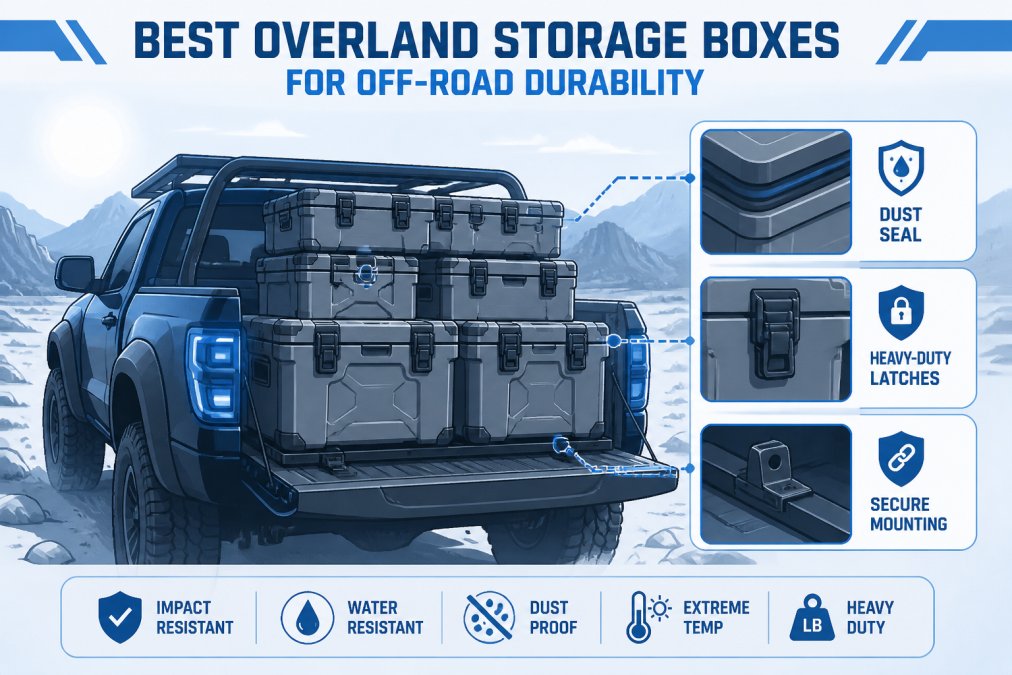
Hard-shell storage boxes built from high-density polyethylene (LDPE) represent the most reliable choice for serious overlanding. These boxes maintain structural integrity through repeated impacts, vibration, and extreme temperature swings. Critical features separating expedition-grade boxes from budget alternatives are weatherproof seals, gas struts for safe lid operation on uneven ground, and lockable latches that prevent accidental opening during trail navigation.
Precision Upgrades offers the 70L Overland Gear Box Gray and 50L Overland Gear Box Gray, both engineered for trail-ready durability. The 70L model delivers 27.25" × 17.5" × 13.5" external dimensions with 21.75" × 12" × 12" usable interior space, weighing 21 pounds empty. The 50L variant provides 24.5" × 15" × 14" external dimensions with 19.25" × 9.25" × 12" interior space and 17-pound base weight. Both feature dust and waterproof seals, gas struts, sturdy handles, lockable latches, drain plugs, tie-down holes, pre-mounted rivnuts for custom modifications, and stackable design.
Stackable design maximizes vertical space in truck beds or SUV cargo areas while maintaining gear access. Pre-mounted rivnuts allow custom MOLLE panel integration, internal dividers, or mounting hardware without compromising weatherproof seals.
Position heavier boxes low and forward in your cargo area to maintain proper center of gravity. A 70L box filled with camping equipment and tools can easily reach 80-100 pounds. Proper weight distribution prevents rear-heavy instability on technical terrain and reduces suspension wear.
Overland Drawer System vs Storage Bins: Which Fits Your Build
Drawer systems prioritize quick-access organization with sliding mechanisms that extend from your vehicle. Storage bins prioritize protected cargo management and stackability. Understanding when each approach delivers better results prevents costly mistakes in your build.
Drawer systems use heavy-duty slide mechanisms and internal dividers to organize gear by category. You can reach tools, recovery equipment, or camping supplies without unloading everything else. This quick-access design works exceptionally well for tools you'll use throughout the day, recovery straps, jacks, and first aid kits. The trade-off is that drawer systems consume more vertical space and typically hold less total volume than equivalent-sized storage boxes.
Modular storage bins like the DMOS Rally Bag series offer flexible soft-shell organization. The DMOS Rally Bag Olive and DMOS Rally Bag Alloy, both priced at $129 each, compress around gear and minimize wasted space. They're ideal for expedition supplies that don't require rigid protection, sleeping gear, clothing, camp kitchen items, or backup fuel containers.
| Storage Type | Best For | Access Speed | Weight Capacity | Stackability | Cost |
|---|---|---|---|---|---|
| Drawer System | Daily-use tools, quick recovery | Immediate | Medium (50-70 lbs per drawer) | Limited | Higher |
| Hard-Shell Bins | Protected cargo, extended trips | Moderate (remove bin) | High (80-100 lbs per bin) | Excellent | Medium |
| Soft-Shell Bags | Flexible loads, weight distribution | Moderate | Medium (40-60 lbs per bag) | Good | Lower |
Weekend trips requiring frequent tool access favor drawer systems. Three-week backcountry expeditions favor hard-shell bins or soft-shell bags for better protection and cargo management. Many experienced overlanders use both: drawers mounted low for daily tools, stacked storage boxes above for expedition supplies.
Hard-Shell vs Soft-Shell Storage: Weight and Accessibility Trade-offs
Hard-shell and soft-shell storage represent opposite ends of the durability-flexibility spectrum. Your choice depends on gear volume, terrain difficulty, and whether you need rapid access to specific items.
Hard-shell storage boxes provide maximum impact resistance and weatherproof protection. They maintain shape under load, resist punctures, and protect contents from dust, water, and UV damage. The 70L and 50L boxes from Precision Upgrades feature LDPE construction that withstands repeated impacts. Hard-shell boxes perform exceptionally well on rocky terrain where loose gear could shift violently. The downside is that hard shells are heavier (21 pounds for the 70L empty) and require more mounting hardware.
Soft-shell storage bags prioritize weight efficiency and packing flexibility. DMOS Rally Bags weigh significantly less than hard-shell equivalents, reducing overall payload and improving fuel efficiency on extended trips. Soft shells compress around irregular gear shapes, eliminating wasted space. However, soft shells offer less impact protection, can develop tears under sharp edges, and don't seal as effectively against dust and moisture.
A 70L hard-shell box holds roughly 70 liters of cargo but weighs 21 pounds empty. A soft-shell bag of similar capacity weighs 3-5 pounds. Carrying the same gear in soft-shell reduces total vehicle weight by 16-18 pounds, translating to better fuel economy, reduced suspension stress, and improved off-road handling over three-week expeditions.
Hard-shell boxes require opening the lid and digging through contents to find specific items. Soft-shell bags can be partially unzipped and items extracted from the top without full unpacking. This matters when accessing first aid supplies, snacks, navigation tools, or emergency equipment throughout the day.
Many expedition veterans use a hybrid approach: one hard-shell box for tools and recovery equipment that rarely moves, soft-shell bags for clothing and camp supplies accessed frequently. This combination optimizes both protection and accessibility without excessive weight.
Overland Gear Organization Tips for Trail-Ready Expeditions
Proper gear organization prevents frustration on the trail and ensures critical equipment remains accessible when needed. The difference between a well-organized expedition and a chaotic one often determines whether you solve problems efficiently or waste hours searching for items.
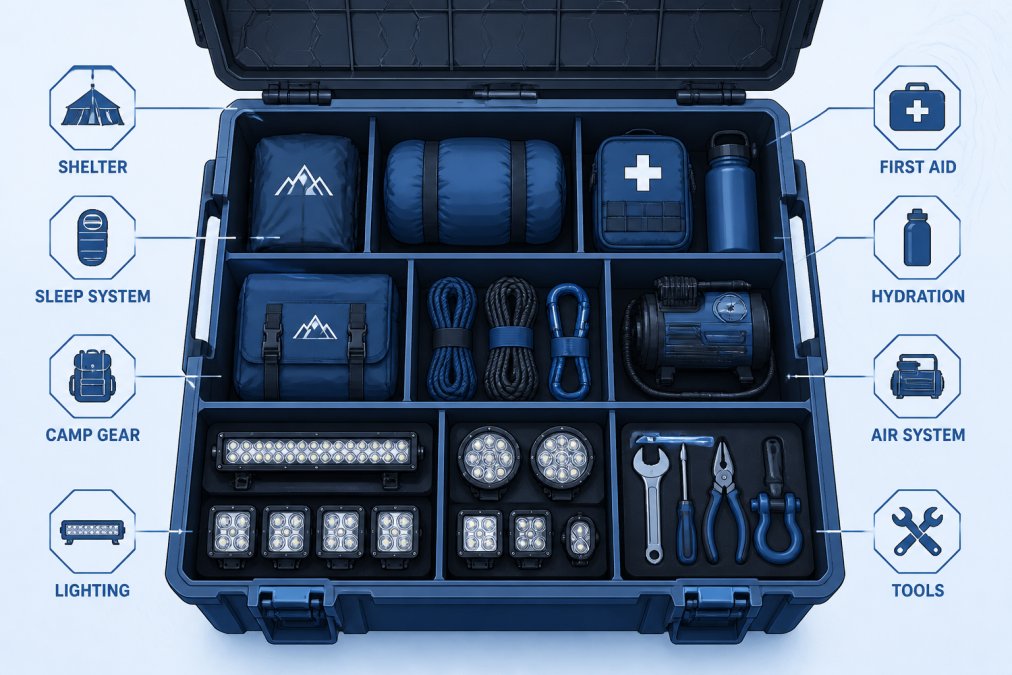
Start with category-based organization. Group recovery equipment together: jacks, straps, shackles, and winch accessories in one location. Keep camp kitchen items in a separate bin. Store spare parts, fluids, and maintenance tools in their own container. This system prevents opening multiple boxes to find what you need. When stuck on difficult terrain or dealing with mechanical issues, quick access to recovery tools directly impacts your ability to self-rescue.
Use internal dividers to maximize vertical space and prevent gear from shifting during rough driving. Pre-mounted rivnuts on Precision Upgrades storage boxes allow installing custom dividers matching your specific cargo. Dividers reduce vibration-related wear, prevent sharp tools from puncturing soft items, and make inventory checks faster.
Place heavier items on the bottom and toward the front of each box to lower center of gravity and improve vehicle stability. Distribute weight evenly across multiple boxes rather than loading one to maximum capacity while leaving others partially empty.
Label everything clearly using waterproof labels or paint markers to identify box contents from the outside. Include a simple inventory list inside each box so you know what should be there and can identify missing items before departing camp.
Implement a "first in, last out" principle for expedition supplies. Items needed immediately upon arrival, camp setup gear, cooking equipment, sleeping systems, should be packed last so they're accessible first. Recovery equipment and emergency supplies should be packed first and remain undisturbed unless needed.
DIY and Budget-Friendly Overland Storage Solutions
Building your own storage system costs significantly less than purchasing pre-manufactured boxes but requires careful planning to ensure durability and functionality.
The most common DIY approach uses plastic storage containers from hardware retailers. Standard 50-60 liter plastic bins cost $20-40 each and provide basic weatherproofing. Limitations include lack of gas struts, lockable latches, and vibration dampening. Adding aftermarket gas struts, quality latches, and heavy-duty tie-down straps brings total cost per custom box to $80-120.
Wooden box construction offers another budget alternative. Building from pressure-treated lumber costs $40-60 in materials with plywood interior dividers, rubber weatherstripping, and heavy-duty hinges. The advantage is complete customization; the disadvantage is that wood absorbs moisture and deteriorates over time, requiring regular maintenance.
Soft-shell bag systems like the DMOS Rally Bags represent the most affordable premium option. At $129 per bag, they cost less than half the price of hard-shell boxes while providing adequate protection for non-fragile cargo.
The real cost of DIY solutions is time investment and potential failures. A homemade box developing a leak mid-expedition can destroy expensive gear and compromise your ability to continue the trip. Commercial boxes from Precision Upgrades include engineered weatherproof seals, tested mounting systems, and manufacturer support. For serious expeditions where gear protection impacts safety, the premium for manufactured boxes typically provides better value.
Securing Your Cargo: Tie-Down Systems and Anti-Theft Features
Securing gear during off-road driving prevents loss through vibration-induced shifting and protects against theft when your vehicle is parked at trailheads or remote campsites.
Tie-down systems must accommodate specific mounting points on your vehicle. Truck beds typically feature tie-down cleats, bed rails, or MOLLE systems. SUVs may require roof racks, cargo nets, or interior tie-down points. Storage boxes from Precision Upgrades include tie-down holes under the lid and pre-mounted rivnuts allowing custom tie-down hardware installation. Use heavy-duty straps rated for at least 500 pounds of holding force. Ratchet straps work better than bungee cords for off-road use because they maintain consistent tension despite vibration and temperature changes.
Position boxes as low as possible in your cargo area. Elevating boxes increases center of gravity and amplifies vibration effects. Secure boxes at multiple points: front and rear tie-downs prevent forward/backward movement, side straps prevent lateral shifting. Leave minimal space between boxes to reduce movement. Many overlanders use foam padding or rubber isolation pads under box feet to absorb vibration and reduce noise.
Lockable latches on storage boxes prevent casual theft. The boxes from Precision Upgrades feature heavy-duty latches that can be secured with padlocks. Use hardened steel padlocks rated for outdoor use. Consider cable locks threading through tie-down holes and around boxes to prevent removal of entire boxes. GPS tracking devices hidden inside expensive gear provide recovery options if theft occurs.
Park in visible, well-lit areas when possible. Use steering wheel locks or brake pedal locks to deter vehicle theft. Install motion-sensor lighting that activates when someone approaches your vehicle at night.
Overlanding storage solutions must balance protection, accessibility, weight efficiency, and cost to match your specific expedition requirements. Whether you choose hard-shell boxes from Precision Upgrades for maximum durability, soft-shell bags for flexibility, or a hybrid system combining both approaches, the key is matching your storage system to your actual cargo needs and terrain challenges.
Precision Upgrades provides the engineered durability and quick-access organization that serious overlanders depend on. The 70L Overland Gear Box Gray and 50L Overland Gear Box Gray deliver weatherproof protection with stackable design and mounting flexibility. Pair these with the DMOS Rally Bags for soft-shell flexibility, or add an ICECO portable cooler for food and water management. Get started with Precision Upgrades and build a trail-ready storage system engineered for extended backcountry expeditions. Use code ADVENTURE15 for 15% off your first order with newsletter signup.
Frequently Asked Questions
What are the best storage containers for overlanding?
The best overland storage containers combine weatherproof sealing, durable construction, and secure mounting. Hard-sided boxes like the 70L Overland Gear Box offer dust-proof protection and lockable latches, making them ideal for multi-week expeditions. Look for containers with gas struts for easy lid operation, internal dividers for gear organization, and tie-down holes to secure cargo during rough terrain. Capacity should match your trip length: 50L boxes work for weekend trips, while 70L options suit extended backcountry adventures.
How do I choose between drawer systems and storage bins for my truck?
Drawer systems excel at quick access and vertical space optimization, while storage bins prioritize payload capacity and weatherproofing. Drawer systems work best if you access gear frequently during trips and need organized compartments. Storage bins are superior for long-term durability in harsh conditions and for stacking multiple containers to maximize truck bed space. Consider your vehicle's payload capacity: bins are heavier but stackable, while drawers distribute weight lower in the bed. For most overlanders, a hybrid approach combining one storage box with a portable cooler offers the best balance.
What makes overland storage different from regular camping storage?
Overlanding storage must withstand vibration, dust, and water exposure across hundreds of miles on unimproved terrain. Overland boxes feature reinforced LDPE construction, weatherproof seals with drain plugs, and heavy-duty latches rated for constant movement. Regular camping storage lacks vibration dampening and dust-proof engineering. Additionally, overland gear boxes include rivnuts and tie-down holes for secure mounting, essential for maintaining center of gravity and preventing cargo shift on steep grades or rocky trails.
Are soft-sided or hard-sided storage cases better for off-roading?
Hard-sided cases outperform soft-sided options for serious off-roading due to superior impact resistance, weatherproofing, and load-bearing capacity. Hard boxes protect contents from punctures and crushing impacts on rough terrain and maintain structural integrity after years of vibration exposure. Soft bags excel at flexibility and weight savings for shorter trips but lack the dust sealing and long-term durability required for extended expeditions. For trail-ready builds, hard-sided storage boxes are the industry standard among overlanders tackling remote backcountry routes.
This article was written using GrandRanker