
Table of Contents
- Suspension Lift Kits and Coil-overs: Foundation for Off-Road Capability
- All-Terrain vs Mud-Terrain Tires: Choosing Your Tire Type
- Skid Plates, Rock Sliders, and Underbody Protection
- LED Lighting Upgrades and Visibility on the Trail
- Essential Off-Road Recovery Gear Every Truck Needs
- Roof Racks, Cargo Management, and Overlanding Gear
- Overland Truck Build Checklist: Weight, Payload, and System Integration
- Legal, Insurance, and Maintenance Considerations
Last Updated: August 13, 2026
Suspension Lift Kits and Coil-overs: Foundation for Off-Road Capability
A suspension lift kit is the single most important upgrade for off-road capability. It increases ground clearance, improves approach and departure angles, and allows for larger tires, all essential for tackling rough terrain. Without proper suspension geometry, your truck remains vulnerable to high-centering on rocks and obstacles.
Lift kits come in two primary types: coil-overs and traditional springs with add-a-leaf or spacer systems. Coil-overs offer superior adjustability and dampening control, managing articulation more effectively so your wheels maintain contact with the ground over obstacles. This translates to better traction and predictable handling.
When selecting a lift kit, consider your truck's GVWR (Gross Vehicle Weight Rating) and payload capacity. A quality coil-over system integrates with your truck's chassis geometry, maintaining drivability on both pavement and trail.
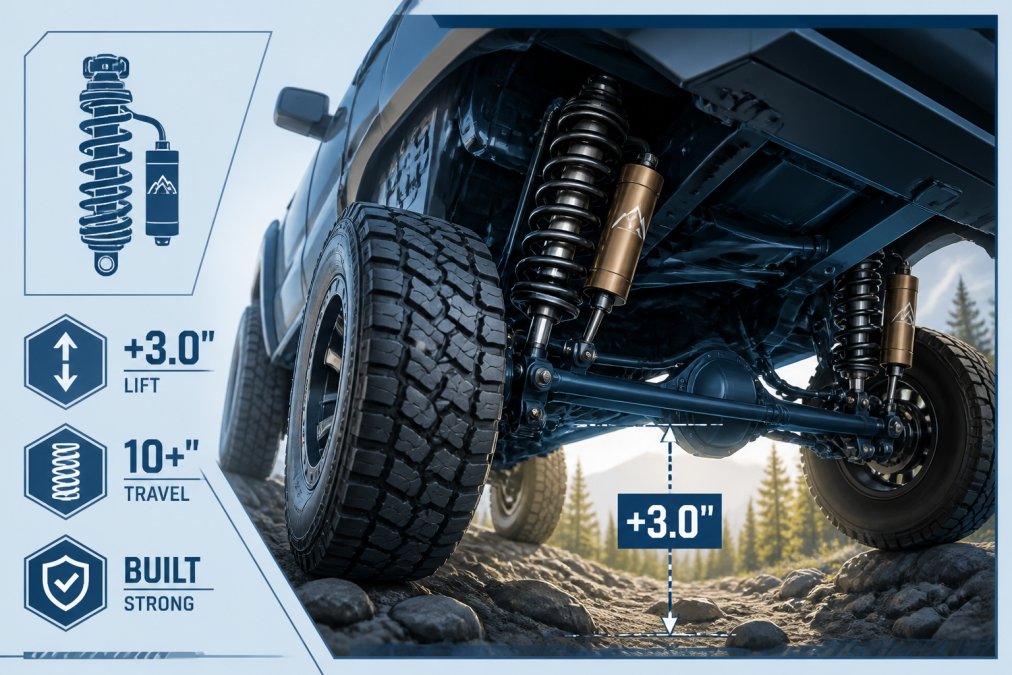
Articulation, how far your suspension extends and compresses while keeping all four wheels planted, wins trails. Coil-over systems with remote reservoirs handle this better because shock fluid stays cooler during extended use, maintaining consistent dampening performance.
Installation complexity varies. Some kits bolt onto existing mounts; others require welding or frame modifications. Budget 8-16 hours for professional installation. DIY installation is possible with suspension experience, but mistakes affect safety and handling.
All-Terrain vs Mud-Terrain Tires: Choosing Your Tire Type
Tire selection defines your off-road capability more than any other single component. All-terrain tires balance highway performance with light trail capability. Mud-terrain tires prioritize traction in extreme conditions but sacrifice on-road comfort and fuel efficiency.
All-terrain tires feature tighter tread patterns with moderate sidewall thickness, excelling on mixed surfaces: dirt roads, gravel, light rock crawling, and sand. They maintain reasonable highway manners, making them ideal for weekend adventurers who value versatility.
Mud-terrain tires have aggressive, widely-spaced tread blocks and reinforced sidewalls, biting harder in mud, snow, and loose rock. The downside is measurable: they're noisier on pavement, wear faster on highways, and reduce fuel economy. For serious mud or extreme rock crawling, mud-terrains earn their place; for occasional off-road use, they're overkill.
Tire pressure affects performance dramatically. Lower pressure increases the tire's footprint, improving traction on soft surfaces. Many experienced overlanders carry a portable compressor to adjust pressure between terrain types. Consider sidewall thickness and load rating carefully, thicker sidewalls resist punctures and allow lower pressures, while load rating must match or exceed your truck's loaded weight.
Skid Plates, Rock Sliders, and Underbody Protection
Underbody protection prevents catastrophic damage when you hit rocks, logs, or obstacles. Skid plates shield your engine, transmission, transfer case, and fuel tank. Rock sliders protect your vehicle's sides while providing recovery points.
Steel skid plates offer maximum protection but add significant weight. Aluminum skid plates weigh less while still providing solid defense. The choice depends on your truck's payload capacity and trail intensity.
Rock sliders serve dual purposes: they protect rocker panels and doors from side impacts, and they provide secure attachment points for recovery gear. When your truck gets stuck, rock sliders become anchor points for winches or straps.
Installation typically requires drilling into your frame or welding to existing structure. Professional installation ensures proper alignment and secure attachment. Coverage matters more than material, comprehensive protection means covering engine, transmission, transfer case, fuel tank, and differential. Precision Upgrades carries systems designed for complete underbody defense.
LED Lighting Upgrades and Visibility on the Trail
LED auxiliary lighting transforms your night-driving capability. Factory headlights struggle on unlit trails with obstacles and shadows. LED light bars and pods multiply your illumination, revealing terrain details that stock lighting misses.
LED technology outperforms halogen systems: brighter output per watt, less heat generation, lower power consumption, and longer lifespan. A quality LED bar uses less electrical draw than upgraded halogens while delivering superior visibility.
Placement affects effectiveness. A roof-mounted light bar illuminates terrain ahead and to the sides. Pod lights mounted lower on the bumper reduce glare and illuminate immediate trail. Many overlanders combine both for dual-setup clarity.
Moisture and corrosion are real concerns. Quality matters more than price. Precision Upgrades offers sealed LED systems designed for overlanding, with proper gaskets and durable housings that resist moisture infiltration.
Wiring requires proper gauge and fusing. Undersized wiring creates fire hazard; improper fusing means lights cut out when needed most. Professional installation ensures your lighting system won't compromise your truck's electrical integrity.
Essential Off-Road Recovery Gear Every Truck Needs
Recovery gear keeps you moving when stuck. A winch, recovery tracks, shackles, and straps form the core of any serious off-road toolkit.
A winch rated for at least 1.5 times your truck's weight provides reliable pulling power. Synthetic rope weighs less than steel cable and won't snap back if it breaks. Proper rigging technique matters more than equipment specs.
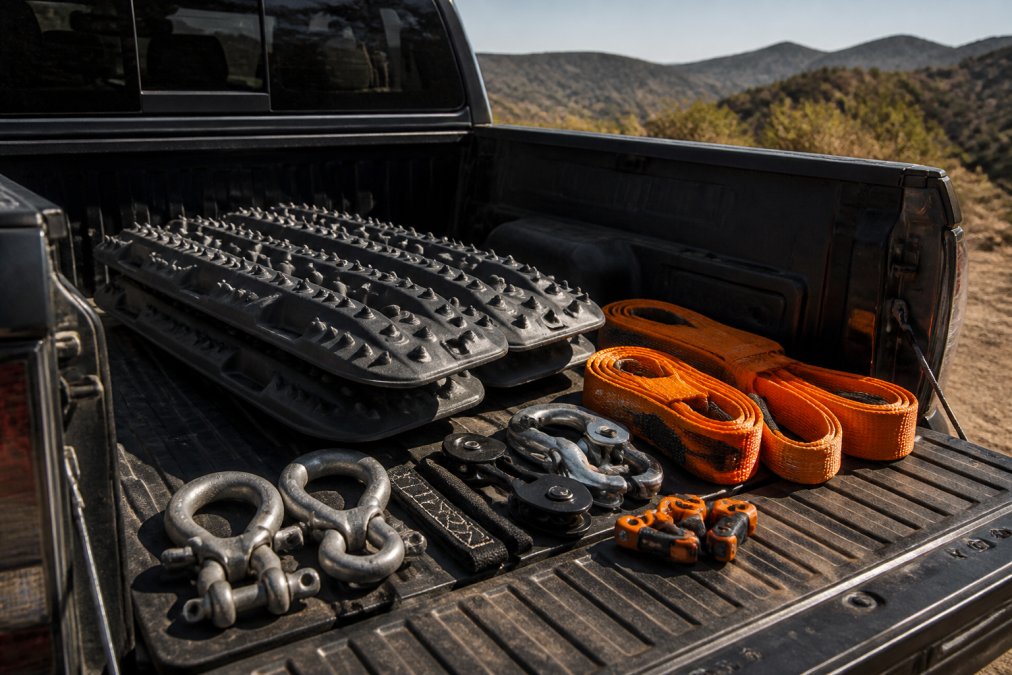
Recovery tracks like the MAXTRAX XTREME provide traction when wheels spin uselessly in sand, mud, or snow. These tracks cost far less than a winch but solve many stuck situations without needing an anchor point. Experienced overlanders carry them as backup even with a winch.
Shackles and straps connect your vehicle to anchor points. Proper shackles are rated for your truck's weight; straps should be rated for at least 20,000 pounds. Keep multiple sizes for different configurations.
A basic recovery kit weighs 80-120 pounds and costs $400-800. The MAXTRAX XTREME tracks run $429.99 and represent excellent value. This is non-negotiable equipment for serious off-road travel.
Roof Racks, Cargo Management, and Overlanding Gear
Roof racks multiply your cargo capacity without sacrificing payload or bed space. A quality rack holds 150-200 pounds safely, allowing you to carry rooftop tents, cargo boxes, or fuel cans.
Rooftop tents like the Tuff Stuff Alpine 61 Hardshell ($4,620.00) provide elevated sleeping with weather protection. Aluminum construction resists corrosion. Setup takes under a minute upon arrival.
Awnings extend your camp's usable space. The Tuff Stuff 270 Degree Awning XL ($850.00) deploys from your vehicle's side, creating shade and shelter. Installation is straightforward with minutes to deploy.
Cargo organization prevents gear from shifting during rough driving. Proper tie-down points and storage boxes keep everything secure and accessible. Weight distribution matters critically, roof-mounted weight should be balanced front-to-back. Unbalanced loading affects handling and can cause instability.
Overland Truck Build Checklist: Weight, Payload, and System Integration
Building a complete off-road truck requires systematic thinking. You're creating an integrated system where each component affects others.
Start with your truck's specifications: GVWR, payload capacity, towing capacity, and electrical system capacity. These numbers define what you can safely add. Calculate weight carefully: suspension upgrades add 200-400 pounds, winches add 100-150 pounds, skid plates add 150-300 pounds, rooftop tents add 100-200 pounds. Total these additions against your available payload.
| Component | Typical Weight | Installation | Cost Range |
|---|---|---|---|
| Coil-over suspension kit | 200-400 lbs | Professional recommended | $1,200-3,000 |
| Skid plate system | 150-300 lbs | Professional installation | $400-1,200 |
| LED light bar | 20-50 lbs | DIY or professional | $300-1,000 |
| Winch | 100-150 lbs | Professional installation | $800-2,500 |
| Rooftop tent | 100-200 lbs | DIY installation | $2,000-5,000 |
| Recovery gear | 80-120 lbs | N/A | $400-800 |
Electrical capacity becomes critical on extended trips. LED lighting, winches, and refrigeration draw significant amperage. Many overlanders upgrade to higher-output alternators or add auxiliary batteries. Integration means ensuring all systems work together, your winch needs proper fusing, lighting needs dedicated circuits, and rooftop tent needs solid rack attachment. Professional installation ensures everything works cohesively.
Legal, Insurance, and Maintenance Considerations
Off-road modifications affect your vehicle's legal status and insurance coverage. Check local regulations before installing significant modifications. Some jurisdictions restrict lift height, tire size, or light placement.
Maintenance demands increase with modifications. Lifted trucks experience different wear patterns. Budget for increased maintenance and use quality parts. Insurance coverage for off-road use varies significantly. Disclose all modifications to your insurance agent. Accurate documentation protects you if something goes wrong.
Extended trips require different preparation than weekend excursions. Service everything before departure: fluids, filters, brakes, belts, hoses. Carry spare parts for items likely to fail. Know your truck's systems well enough to diagnose problems in remote areas.
Building an off-road truck requires balancing capability, weight, legality, and budget. The components that matter most are suspension, tires, protection, and recovery gear. Start with a solid foundation, add protection, ensure proper weight distribution, and maintain everything religiously. Precision Upgrades offers premium overlanding gear and LED lighting specifically designed for this journey. Whether you're planning weekend adventures or extended backcountry trips, quality equipment transforms your truck into a genuine trail-capable platform.
Frequently Asked Questions
What are the most essential first upgrades for an off-road truck?
Start with suspension lift kits or coil-overs to increase ground clearance and articulation, then upgrade to all-terrain or mud-terrain tires suited to your terrain. Add skid plates for underbody protection, install essential off-road recovery gear like MAXTRAX tracks and a winch, and upgrade lighting for visibility. These foundational upgrades significantly improve your truck's off-road capability without breaking your budget.
How do I choose between all-terrain and mud-terrain tires?
All-terrain tires work well for mixed on-road and light off-road use, offering better highway performance and durability. Mud-terrain tires excel in extreme conditions like deep mud, rocks, and sand, but sacrifice on-road comfort and fuel efficiency. Consider your primary use: weekend trail trips favor all-terrain, while serious overlanding or mud-heavy terrain demands mud-terrain. Tire pressure management is equally important, lower pressure improves traction but requires careful monitoring.
Is a suspension lift kit necessary for light off-roading?
Not always. Light off-roading on maintained trails works with stock suspension, but a lift kit dramatically improves approach angle, departure angle, and ground clearance, reducing underbody damage risk. Coil-over suspensions add articulation and dampening control for better traction and handling. If you plan regular trails or rough terrain, a lift kit is worth the investment. Budget-tier options start around $1,000-$2,000; pro-tier systems offer superior geometry and durability.
What recovery gear should every off-road truck carry?
Essential off-road recovery gear includes MAXTRAX recovery tracks (like the MAXTRAX XTREME at $429.99), a winch with rated capacity, recovery shackles, heavy-duty straps, and a snatch block. Add a first-aid kit, water, and basic tools. Recovery points on your chassis must be rated for your truck's weight. Many overlanders also carry a portable cooler and communication devices. This gear transforms a stuck situation from dangerous to manageable.
How do I know what upgrades will fit my specific truck model?
Check your truck's GVWR (Gross Vehicle Weight Rating) and payload capacity, upgrades add weight, and exceeding payload limits affects handling and safety. Verify fitment compatibility with your model year and trim level; many suspension kits, skid plates, and roof racks are model-specific. Precision Upgrades products list compatibility details; always confirm before purchasing. When in doubt, consult your truck's manual or contact the manufacturer for fitment guidance.
Will upgrading my truck for off-road use affect my insurance coverage?
Yes. Significant modifications like lift kits, bumpers, and aftermarket lighting may require notifying your insurance provider. Some policies exclude coverage for modified vehicles in certain conditions, or premiums may increase. Disclose all major upgrades to avoid claim denial. Some insurers specialize in modified vehicles and offer better rates. Check your policy language and contact your agent before making substantial upgrades to ensure continuous coverage.
How do I balance off-road capability with on-road comfort and drivability?
Choose coil-over suspensions with adjustable dampening, they handle both trails and highways better than fixed lifts. Select all-terrain tires if you drive highways frequently; they offer quieter, more comfortable rides than mud-terrain. Avoid extreme modifications that sacrifice ride quality. Budget-tier upgrades prioritize functionality; pro-tier systems engineer better on-road performance. Test-drive upgraded trucks before buying to understand the trade-offs between capability and daily drivability.
What's included in a complete overland truck build checklist?
An overland truck build checklist covers: suspension (lift kit or coil-overs), tires (all-terrain or mud-terrain), underbody protection (skid plates, rock sliders), lighting (LED bars and pods), recovery gear (winch, MAXTRAX, shackles), cargo management (roof rack, awning like the Tuff Stuff 270 Degree Awning XL at $850), sleeping setup (rooftop tent like the Tuff Stuff Alpine 61 at $4,620), power management, water/cooler systems, and communication devices. Prioritize based on your trip duration and terrain difficulty.
This article was written using GrandRanker