
Table of Contents
- Premium Overlanding Gear Delivers Real Safety and Reliability
- Recovery and Self-Reliance: The Cost of Failure in Remote Terrain
- Essential Overlanding Recovery Gear: What Separates Premium From Adequate
- Durability, Weatherproofing, and Long-Term Liveability
- Budget vs Premium Overlanding Gear: Where Premium Justifies the Investment
- Power Management and Off-Grid Capability
- Navigation, Communication, and Expedition-Grade Redundancy
- Conclusion
Last Updated: August 6, 2026
Premium Overlanding Gear Delivers Real Safety and Reliability
When you're 200 miles from the nearest road, your gear doesn't fail gracefully. It fails completely. That's the fundamental difference between casual outdoor equipment and premium overlanding gear.
Premium overlanding gear bridges the gap between what works at home and what survives in conditions where professional help is hours or days away. Budget alternatives might handle a weekend trip to a developed campground. Extended off-grid expeditions demand equipment engineered for field failure, extreme temperature swings, and repeated abuse that would destroy consumer-grade products within weeks.
This guide covers the technical and financial case for premium overlanding gear, where premium justifies its price tag, where budget alternatives suffice, and how to evaluate durability beyond marketing claims. If you're planning serious off-road travel, the decisions you make about gear quality directly determine whether your adventure succeeds or becomes a survival situation.
Recovery and Self-Reliance: The Cost of Failure in Remote Terrain
The moment your vehicle gets stuck in genuine backcountry terrain, you're no longer shopping, you're surviving. Recovery isn't a feature. It's insurance against catastrophic outcomes.
Budget recovery gear typically means a basic winch rated for your vehicle's weight. Premium systems add field-repairable design, redundant power pathways, and mechanical simplicity that keeps them functional after impacts that would disable cheaper units. The difference becomes critical when you're extracting a vehicle at 8,000 feet elevation in fading light, with limited battery power and no cell signal.
A premium winch system includes sealed electrical connections that resist moisture infiltration, mechanical brakes that hold under stress without power, and cable or synthetic rope designed to survive repeated cycles without fraying or core separation. Budget winches often feature exposed connections, electronic-dependent holding mechanisms, and rope that degrades visibly after 5-10 recovery cycles.

A premium recovery system works on your 10th use and your 100th use. Budget systems often don't make it to 20. In remote terrain where a failed recovery attempt means spending an unplanned night in your vehicle without proper shelter or a multi-day wait for external assistance, that difference determines whether you drive out or get extracted by helicopter.
Self-reliance in overlanding means carrying the capability to extract yourself without external help. That requires recovery gear rated well above your vehicle's weight, electrical systems designed to function when the main battery is depleted, and mechanical components that don't require specialized tools or replacement parts you can't source in the field.
Premium overlanding gear emphasizes redundancy. Dual battery systems, auxiliary power distribution with multiple circuit protection strategies, and recovery equipment with manual override options ensure that a single failure doesn't cascade into total system collapse.
Essential Overlanding Recovery Gear: What Separates Premium From Adequate
Recovery equipment exists on a spectrum. Understanding what separates adequate from premium requires looking beyond product ratings and into field reliability.
Winch Systems and Traction Solutions
A winch rated for your vehicle's weight is the baseline. Premium units feature sealed electrical contacts rated for full submersion, mechanical holding brakes that engage passively if power fails, and control systems designed for one-handed operation in poor visibility.
Field-repairable design matters more than most buyers realize. Premium winch motors use standard brushes and bearings available at automotive suppliers. Budget motors often feature proprietary components that can't be replaced in the field. A premium synthetic rope resists UV degradation and maintains integrity after repeated thermal cycles. Budget rope frays and fails under load after 15-20 cycles.
Premium traction solutions distribute weight across a larger footprint, resist bending under extreme loads, and feature attachment points engineered to withstand side forces. Budget boards often bend permanently after 2-3 uses in rocky terrain, making them unreliable for subsequent recovery attempts.
Field-Repairable Design and Mechanical Reliability
Premium overlanding gear prioritizes mechanical simplicity over electronic integration. Electronics fail predictably in extreme conditions, while mechanical systems fail less frequently and can be repaired with basic tools.
A premium auxiliary power system uses heavy-gauge wiring with crimped, sealed connections. Budget systems use thinner wire and solder joints that fail under vibration. Premium battery isolators use mechanical relays. Budget versions use electronic controllers that fail under sustained high current draw.
Field repairability means every component can be diagnosed and replaced using tools that fit in a small pack. Premium gear features standardized fasteners, accessible connection points, and modular design. The overlanding community tracks failures across thousands of builds: premium brands see component failures at 5-10% rates over multi-year use in harsh conditions. Budget alternatives see failure rates of 30-50% within the first two years.
Durability, Weatherproofing, and Long-Term Liveability
Extended overlanding trips mean your gear experiences temperature swings of 50+ degrees Fahrenheit, repeated wet-dry cycles, dust infiltration, and vibration that would destroy consumer products. Premium gear is engineered for this environment.
Weatherproofing in premium systems goes beyond sealed connectors. It means gasket materials selected for the specific temperature range you'll encounter, drainage paths that prevent water pooling, and material choices that resist UV degradation. A premium cargo storage system uses stainless steel hardware, powder-coated steel or aluminum bodies, and gaskets rated for -20 to 140 degrees Fahrenheit. Budget systems use zinc-plated steel (which corrodes), plastic hardware (which becomes brittle), and gaskets rated for normal automotive temperatures.
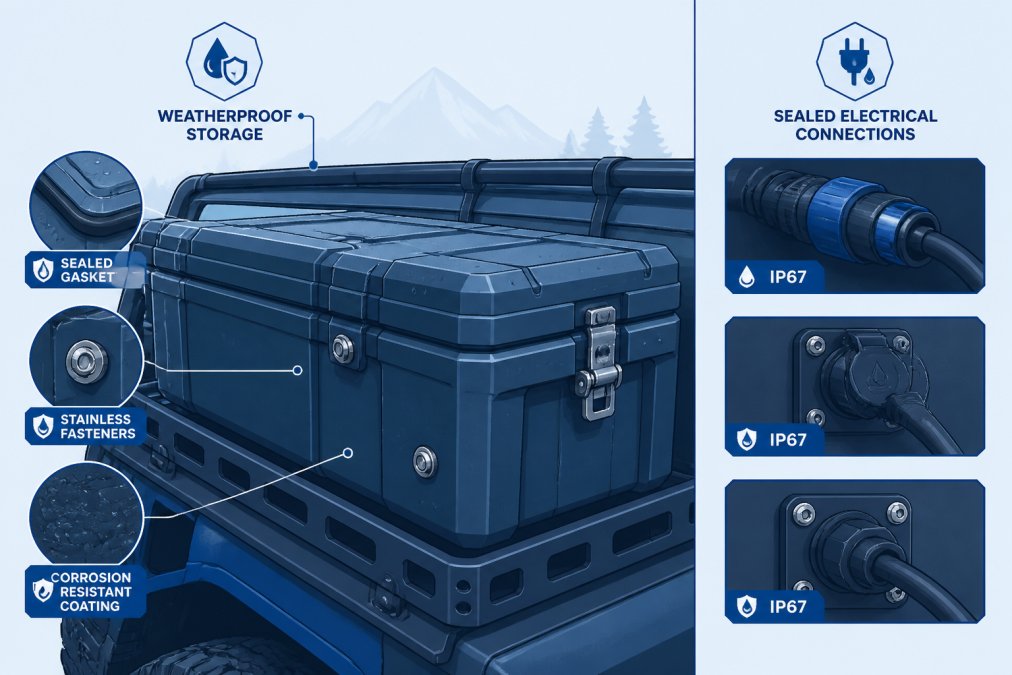
Long-term liveability means your vehicle remains functional and comfortable for weeks at a time in remote conditions. Premium sleep systems use insulation materials that maintain R-value across temperature extremes and ventilation designs that prevent condensation buildup. Budget alternatives often feature thin foam that compresses after 10-15 uses and ventilation that allows moisture accumulation.
Premium kitchen systems prioritize field-repairable design with stainless steel construction, modular burner designs, and redundant fuel supply lines. Budget systems often feature integrated designs where a single failed component requires replacing the entire unit.
Teams running the same overlanding route year after year report that premium gear systems require component replacement every 3-5 years with proper maintenance. Budget systems typically require replacement or major repair within 12-24 months.
Budget vs Premium Overlanding Gear: Where Premium Justifies the Investment
Budget overlanding gear works adequately for occasional weekend trips within 50 miles of civilization. If you're running established routes with cell coverage and the option to turn back if something breaks, budget alternatives reduce your initial investment significantly.
Premium overlanding gear becomes the rational choice when your trips extend beyond reliable cell coverage, when you're traveling routes without established support infrastructure, or when you're planning expeditions longer than 7-10 days. In these scenarios, the cost of failure justifies the premium investment.
Payload Capacity and Weight Distribution
Your vehicle has a manufacturer-rated payload capacity. Budget overlanding builds often ignore this limit, stacking gear until the suspension compresses and the vehicle handles dangerously.
Premium overlanding gear is engineered with weight distribution in mind. Cargo storage systems mount low and centered, maintaining vehicle balance. Auxiliary batteries are positioned to optimize weight distribution. Premium roof racks use aerodynamic designs that reduce wind drag and maintain vehicle stability.
A properly built premium overlanding system distributes 800-1,200 pounds of additional gear in ways that actually improve vehicle handling. Budget systems often create dangerous weight distribution that requires air suspension upgrades just to remain roadworthy.
Resale Value and Long-Term Cost of Ownership
A frequently overlooked factor in the premium versus budget decision is resale value. A vehicle equipped with premium overlanding gear from established manufacturers retains 60-75% of the gear's original value when sold. Budget gear often retains 20-30% of its original value.
If you're planning to keep your overlanding vehicle for 5-10 years, the long-term cost of ownership heavily favors premium gear. The initial premium might be $3,000-$5,000 higher, but the resale recovery and reduced replacement costs over time often make the total cost of ownership equivalent or lower than budget alternatives.
Power Management and Off-Grid Capability
Extended off-grid travel demands power management systems that function reliably across days or weeks without external charging. Budget power systems often deliver adequate voltage but lack the charging redundancy and load management that prevents catastrophic battery drain.
Premium power management systems use multiple charging inputs: alternator charging, solar panel integration, and auxiliary generator compatibility. They feature intelligent load management that prioritizes essential systems and shuts down secondary systems when battery voltage drops below safe thresholds.
Solar integration in premium systems includes MPPT (Maximum Power Point Tracking) controllers that extract 20-30% more energy from panels than basic PWM controllers. Premium wiring uses appropriately sized conductors, minimizing voltage drop across distribution runs. Budget systems often feature undersized wiring that loses 15-25% of available power as heat.
A premium power management system can sustain basic camp operations indefinitely with moderate solar input. Budget systems typically deplete auxiliary batteries within 3-5 days without external charging.
Navigation, Communication, and Expedition-Grade Redundancy
True expedition capability requires navigation and communication systems with redundancy built in. A single GPS unit is insufficient when traveling routes without cellular coverage. Premium overlanding builds include multiple navigation options: primary GPS with offline mapping, backup compass and paper maps, and satellite communication capability for emergency situations.
Communication redundancy means more than a single radio. Premium setups include VHF/UHF radios for team communication, satellite messengers for emergency notification, and backup power systems for all communication devices.
Navigation systems in premium builds use offline mapping that functions without cellular data, allowing real-time route planning adjustments when conditions change. This expedition-grade approach to redundancy applies to all critical systems: two water sources instead of one, dual fuel supplies, multiple methods for starting fires, and backup shelter systems.
Conclusion
Premium overlanding gear matters because off-road adventure in remote terrain demands equipment engineered for failure modes that consumer products never encounter. The price premium reflects real engineering: sealed electrical systems, field-repairable design, redundant power management, and weatherproofing rated for extreme conditions.
The decision between budget and premium overlanding gear depends on your actual use case. Weekend trips near civilization can work with budget alternatives. Extended expeditions in remote terrain demand the reliability that premium gear delivers. Precision Upgrades specializes in expedition-grade overlanding solutions engineered for durability, field repairability, and redundancy, the core attributes that keep vehicles functional when professional help is days away. Shop our curated selection of premium overlanding gear, LED lighting systems, and recovery equipment designed to enhance your vehicle's capability for serious off-road adventure.
| Gear Category | Budget Approach | Premium Approach | Best For |
|---|---|---|---|
| Winch Systems | Basic electric, sealed connections minimal | Sealed electrical, mechanical brake, manual override | Remote recovery situations |
| Power Management | Basic voltage regulation | MPPT solar controllers, intelligent load management | Multi-week off-grid trips |
| Weatherproofing | Standard automotive gaskets | Temperature-rated gaskets, stainless hardware | Extended expedition use |
| Recovery Gear | Single-use rated components | Field-repairable, redundant systems | Self-reliance in terrain |
| Sleep Systems | Thin foam, basic ventilation | Temperature-rated insulation, moisture management | Long-term camp comfort |
| Navigation | Single GPS unit | Offline maps, satellite communication, backup compass | Routes without cell coverage |
Frequently Asked Questions
What makes premium overlanding gear worth the extra cost compared to budget alternatives?
Premium overlanding gear offers field-repairable design, superior weatherproofing, and mechanical reliability that budget options cannot match. When you're three weeks into a remote backcountry trip, a failed storage system or corroded electrical connection becomes a serious problem. Premium gear uses redundancy in critical systems (like dual battery configurations or communication backup), better materials that resist corrosion, and components designed for repair with basic tools rather than replacement. The cost difference often recovers through longer lifespan and avoided emergency recovery situations.
How do I know if essential overlanding recovery gear will actually work with my existing vehicle setup?
Essential overlanding recovery gear like winch systems and traction boards must match your vehicle's weight distribution, payload capacity, and attachment points. Before purchasing, verify your vehicle's GVWR (Gross Vehicle Weight Rating) and current load, then calculate how additional gear affects handling and suspension. Premium gear manufacturers provide detailed compatibility guides and installation documentation. Contact Precision Upgrades directly with your vehicle year, make, and model to confirm fit and ensure your existing accessories integrate properly without requiring replacement.
Is overlanding an expensive hobby, and can I start with budget gear?
Starting with budget overlanding gear often costs more long-term due to replacement cycles, warranty gaps, and potential trail failures. A budget recovery winch that fails mid-extraction may require professional recovery costing thousands. Premium gear typically lasts 10+ years with proper maintenance, while budget alternatives often need replacement after 3-5 years. If you're planning extended off-grid trips, investing in essential overlanding recovery gear upfront, particularly power management, weatherproofing, and recovery systems, delivers better value than upgrading multiple times.
What happens if premium overlanding gear doesn't perform as expected?
Precision Upgrades stands behind its products with a clear return policy and customer support focused on durability and reliability. Before purchasing, review real customer photos and reviews showing gear in actual trail conditions. Premium brands typically offer extended warranties and replacement parts availability, unlike budget competitors. If you have concerns about how specific gear will perform on your planned trip, Precision Upgrades can connect you with installation guidance and technical support to ensure proper setup and realistic performance expectations.
This article was written using GrandRanker