
Table of Contents
- Will Universal Cargo Boxes Fit Your 4Runner?
- 4Runner Roof Rack Crossbar Compatibility with Cargo Boxes
- 4Runner Roof Box Liftgate Clearance: Measuring and Avoiding Interference
- How to Measure Your Roof Rack for Cargo Box Fitment
- Cargo Box Mounting Hardware Types and Installation
- Common Cargo Box Issues: Wind Noise, Aerodynamics, and Off-Road Durability
- Ensuring Your Cargo Box Works with 4Runner Accessories
- Conclusion
Last Updated: August 10, 2026
Will Universal Cargo Boxes Fit Your 4Runner?
The short answer: it depends on your specific 4Runner model year, roof rack configuration, and cargo box dimensions. Universal cargo boxes can work on 4Runners, but compatibility isn't guaranteed without careful measurement and planning. The difference between a seamless installation and a frustrating mismatch comes down to understanding your vehicle's roof architecture and the box's mounting requirements.
A poorly fitted cargo box can damage your vehicle's liftgate, create dangerous wind noise on the highway, or fail to secure properly during off-road adventures. This guide walks you through every factor that determines compatibility, from measuring your crossbar spacing to understanding hatch clearance to evaluating mounting hardware options.
4Runner Roof Rack Crossbar Compatibility with Cargo Boxes
Your 4Runner's roof rack system is the foundation for any cargo box installation. Not all roof racks are created equal, and universal cargo boxes must work within specific constraints.
Factory Crossbars vs. Aftermarket Solutions
Toyota factory crossbars on 4Runners come in two main configurations: standard round bars on most models and recessed channel systems on newer generations. Factory crossbars are typically spaced 54-56 inches apart, though this varies slightly by model year.
Universal cargo boxes designed for round crossbars clamp directly onto the bar with rubber-padded fixtures. Most universal boxes in the 60-75 inch range work reliably on factory round crossbars without additional hardware.
Aftermarket crossbars from brands like Yakima or Thule often use different diameters or mounting profiles. A box designed for 1.5-inch round bars might not grip securely on 1.75-inch bars. Factory crossbars aren't engineered to support unlimited weight distribution. Universal cargo boxes place concentrated loads at specific clamping points, and if your box clamps at two points but your crossbars flex between them, you'll experience movement and noise, especially on rough terrain.
Recessed Channels and T-Slot Mounting Systems
Newer 4Runner models (2024 and later) use recessed channel systems instead of round crossbars. These channels accept T-slot mounting hardware. Universal cargo boxes designed for round bars won't fit these systems without adapter plates.
If your 4Runner has a recessed channel roof rack, you need either a box specifically designed for T-slot mounting or universal adapters that convert T-slot to round-bar clamping. Adapters add cost and create additional connection points where movement can occur.
Check your 4Runner's manual or roof rack documentation to confirm which system you have. This single detail determines whether a universal box will work at all.
4Runner Roof Box Liftgate Clearance: Measuring and Avoiding Interference
This is where most compatibility issues surface. A cargo box that clamps perfectly to your crossbars can still interfere with your liftgate opening if you haven't accounted for clearance.
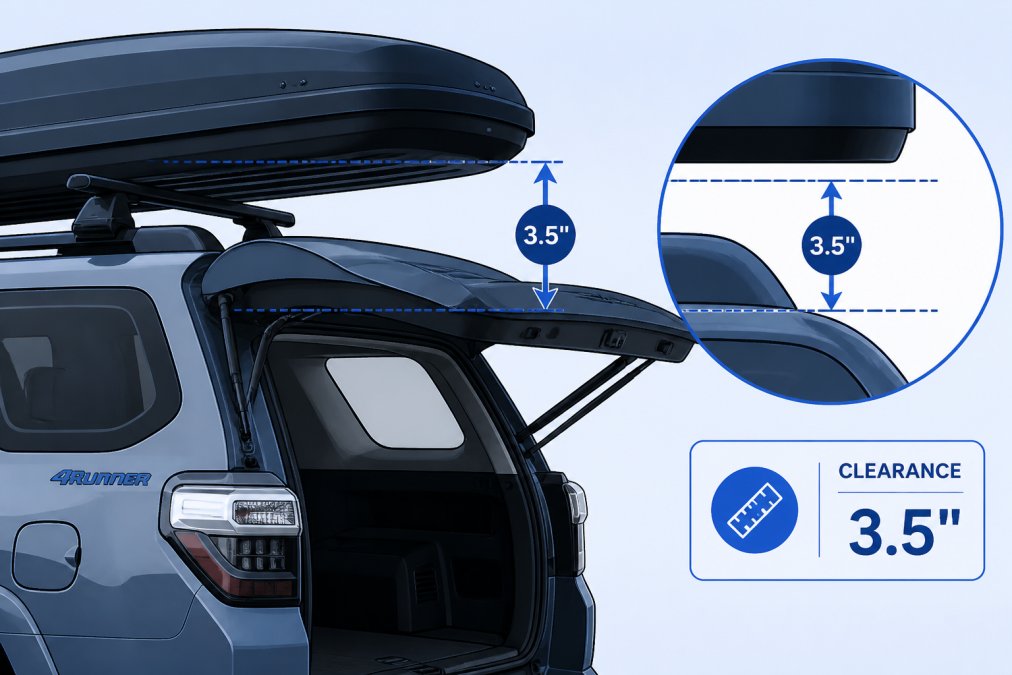
Hatch Interference Measurement Guide
Your 4Runner's liftgate opens upward and slightly forward, extending approximately 12-14 inches above the roofline on most models. A cargo box mounted directly above or behind the liftgate will collide with the hatch as it opens, potentially bending the liftgate, cracking the box, or stripping mounting hardware.
To measure clearance, you need three measurements: (1) the distance from your crossbars to the rear edge of the roof, (2) the length of your cargo box, and (3) how far back the box extends when mounted.
Measure from the front of your crossbars to the rear edge of your roof where the liftgate hinge begins. On most 4Runners, this distance is 18-22 inches. When you mount a 60-inch box on crossbars that are 56 inches apart, roughly 2-4 inches extend behind each crossbar. If your roof has 20 inches of space behind the crossbars and your box overhangs by 3 inches, you have 17 inches of clearance. Your liftgate needs at least 12 inches of clear space to open without contact.
Adjusting Roof Rack Positions for Safe Clearance
If your cargo box extends too far back, you can move the crossbars forward or choose a shorter box.
Moving crossbars forward works only if your roof rack system allows it. Factory Toyota racks usually have fixed mounting points. Aftermarket racks often feature adjustable positions along the roof rails. If your system is adjustable, moving the crossbars forward 4-6 inches can solve interference issues entirely.
Measure carefully before loosening anything. Moving crossbars changes your weight distribution and can affect how your box sits relative to the roof. The practical approach: measure your specific configuration, calculate clearance, and if you're within 3 inches of interference, choose a shorter box or move your crossbars.
How to Measure Your Roof Rack for Cargo Box Fitment
Proper measurement eliminates almost all compatibility guesswork. This process takes 15 minutes and prevents costly mistakes.
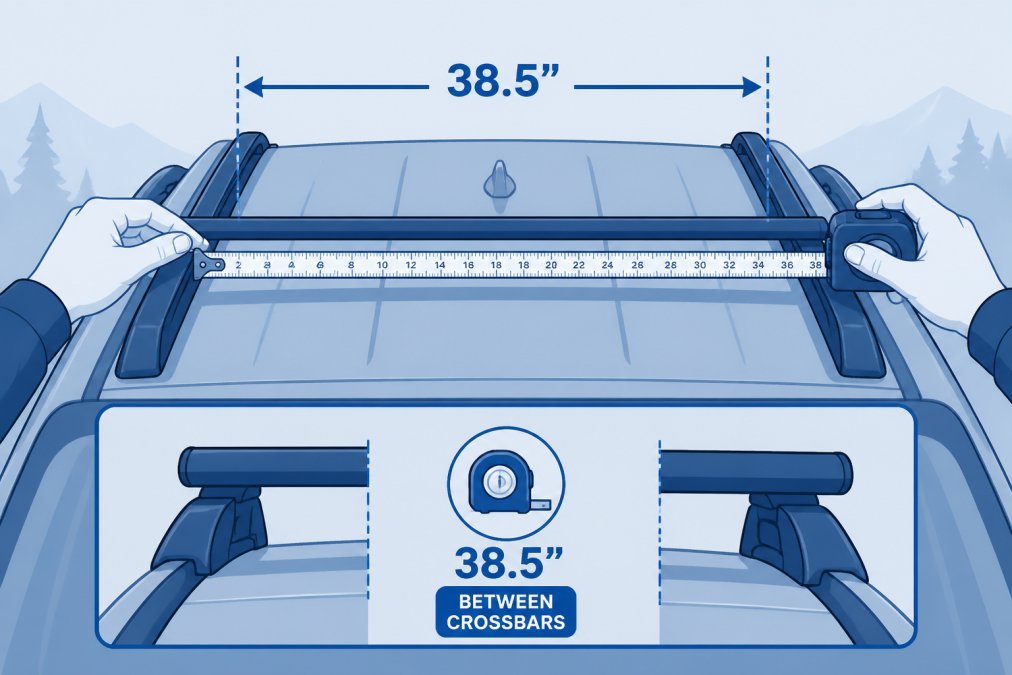
Crossbar Spacing and Clamping Mechanism Requirements
Start by measuring the distance between the center points of your crossbars. Universal cargo boxes specify a range, typically 50-60 inches or 55-65 inches. If your crossbars are 56 inches apart, a box rated for 50-60 inches will work.
Next, measure the diameter of your crossbars. Round bars are typically 1.5 inches, 1.75 inches, or 2 inches in diameter. Most universal boxes accommodate 1.5-1.75 inch bars. If your bars are 2 inches thick, you need a box specifically designed for larger diameters or adapters.
Examine your crossbars for any coatings or protective sleeves. These covers compress slightly when clamping pressure is applied, affecting how securely the box sits. Measure the diameter with the cover in place.
Most universal boxes use a two-point clamping system that distributes load evenly. Some budget boxes use single-point clamps that grip from above only, creating uneven pressure and shifting, especially on rough terrain.
When you measure, also note any obstructions on your roof. Roof antennas, roof rails, or factory racks can interfere with box positioning.
Load Capacity and Weight Distribution
Every cargo box has a maximum load capacity based on how the box is engineered and how securely it clamps to your crossbars.
Universal boxes typically support 100-150 pounds of cargo. Your 4Runner's factory crossbars are usually rated for 150 pounds total. If your cargo box weighs 50 pounds empty and you load it with 100 pounds of gear, you've exceeded the crossbar capacity.
Weight distribution matters as much as total weight. A 150-pound load centered on the crossbars is safer than a 100-pound load positioned entirely over the rear overhang. When weight extends beyond the crossbars, it creates leverage that multiplies the effective load on the mounting points.
For off-road use, weight capacity becomes even more critical. Washboard roads and rocky terrain create impact forces that exceed static weight ratings. Check both the cargo box's weight rating and your crossbar system's rating. Use the lower number as your actual limit, then subtract the box's empty weight to determine how much cargo you can safely carry.
Cargo Box Mounting Hardware Types and Installation
The hardware connecting your cargo box to your crossbars determines whether the installation is rock-solid or prone to movement and noise.
Universal Mounting Systems vs. Vehicle-Specific Hardware
Universal mounting systems use adjustable clamps that accommodate a range of crossbar diameters and spacing. These clamps are flexible but may not grip as securely as vehicle-specific hardware.
Vehicle-specific hardware is engineered for a particular crossbar configuration. A box designed specifically for 4Runner factory crossbars uses clamps that match the exact bar diameter and spacing. The fit is tighter and the box sits more securely.
If you plan to move the box to another vehicle eventually, universal hardware is more practical. If this box will stay on your 4Runner permanently, vehicle-specific hardware is the better choice.
Examine the clamp material. Rubber-padded clamps protect your crossbars from damage and reduce vibration. Metal-to-metal clamps are stronger but can damage anodized or painted bar surfaces over time.
Step-by-Step Installation Process
Installation typically takes 45 minutes to 1.5 hours. Here's the process:
-
Prepare your crossbars. Clean the top surface where clamps will sit. Remove any debris and dry thoroughly.
-
Position the cargo box on the crossbars. Slide the box to the center position. Ensure it's level using a small level tool. Adjust until the box sits evenly.
-
Attach the front clamps. Tighten clamps gradually in a crisscross pattern (front-left, front-right, then back-left, back-right). Don't fully tighten yet.
-
Check clearance with the liftgate. Open your liftgate fully and verify the box doesn't contact the hatch. If it does, reposition the box forward slightly.
-
Fully tighten all clamps. Once clearance is confirmed, tighten each clamp firmly. You should not be able to move the box by hand. Check tightness again after driving 20 miles.
-
Secure any additional hardware. Install safety straps or backup clamps according to the manufacturer's instructions.
-
Test before loading. Drive at highway speeds and listen for wind noise or rattling. If you hear movement, pull over and check clamp tightness.
Load your box gradually. Start with 50 pounds and drive for 10 miles. Verify clamps haven't loosened before adding more weight.
Common Cargo Box Issues: Wind Noise, Aerodynamics, and Off-Road Durability
Once your cargo box is installed and compatible, you'll face practical challenges that affect usability and longevity.
Minimizing Aerodynamic Drag and Wind Noise
Cargo boxes create aerodynamic drag that increases fuel consumption and generates wind noise at highway speeds. Wind noise is typically worst at 55-70 mph and comes from air turbulence around the box edges and vibration in the box itself.
To minimize noise, ensure your box is mounted as securely as possible. Loose clamps amplify vibration. Some boxes include foam padding or vibration-damping strips inside the clamp areas. If your box is noisy, adding adhesive-backed foam to the clamp surfaces can reduce vibration transmission.
Box shape affects aerodynamics significantly. Simplified boxes with rounded edges create less drag than boxy designs. Position your box as far forward on the crossbars as clearance allows. Boxes positioned over the rear overhang create more aerodynamic disturbance. Moving a box forward 4-6 inches can noticeably reduce wind noise.
Off-Road Durability of Plastic Cargo Boxes
Most universal cargo boxes are made from injection-molded plastic or fiberglass-reinforced plastic. These materials are lightweight and corrosion-resistant, but they're not indestructible.
On rough terrain, plastic boxes flex and vibrate more than metal boxes. Washboard roads are particularly hard on plastic boxes because repetitive impacts create fatigue stress. To extend the life of a plastic box on off-road terrain, ensure it's mounted as rigidly as possible with tight clamps.
UV exposure degrades plastic over time. Boxes left in direct sun will become brittle and discolored. If you park your 4Runner outside regularly, consider a protective cover for your cargo box.
Water ingress is another concern. Seals around the box lid can fail, allowing water inside during river crossings or heavy rain. Inspect seals regularly and replace them if they're cracked or deteriorating.
Ensuring Your Cargo Box Works with 4Runner Accessories
Your 4Runner likely has other roof-mounted or rear-mounted accessories. A cargo box must coexist with these without interference or damage.
Roof antennas are common culprits. If your antenna extends above the roofline, a cargo box mounted directly over it will contact the antenna. Relocate your antenna if possible, or choose a box that clears the antenna height.
Roof rails can interfere with clamp positioning. Some universal clamps won't fit if roof rails are in the way. Measure the clearance between your roof rails and verify that clamps can access the crossbars fully.
Rear spoilers or roof-mounted lighting can create additional complications. A cargo box should sit at least 2 inches away from any rear-mounted accessory to allow for vibration and thermal expansion. Measure carefully before installation.
Will universal cargo boxes fit your 4Runner? The answer is yes, if you measure your roof rack configuration, verify liftgate clearance, and choose a box designed for your specific crossbar system. The installation process is straightforward, but the preparation work determines whether you end up with a secure, quiet, reliable storage solution. Take time to measure, verify compatibility, and install carefully. Your 4Runner and your cargo will both benefit from the attention to detail. Explore Precision Upgrades' cargo storage solutions to find the right fit for your vehicle and adventure plans.
Frequently Asked Questions
Do I need specific crossbars to mount a universal cargo box on a 4Runner?
Universal cargo boxes work with factory crossbars on most 4Runner models, but compatibility depends on your crossbar type and spacing. Factory crossbars typically use recessed channels or T-slot systems that accept standard clamping mechanisms. Aftermarket crossbars designed for universal mounting offer more flexibility. Before buying, verify your 4Runner's crossbar spacing (usually 24-30 inches apart) and confirm the cargo box's mounting hardware matches your system. Some universal boxes require adapter kits for factory rails.
How do I know if a cargo box will fit my 4Runner's roof rack?
Check three critical measurements: crossbar spacing, roof height clearance to your liftgate, and the box's mounting footprint. Measure the distance between your roof crossbars, universal boxes typically accommodate 24-30 inch spacing. Verify your liftgate opens fully without hitting the box by measuring from the roof to the top of the open hatch. Finally, confirm the box's base dimensions match your crossbar length. Most universal cargo boxes list compatibility charts for specific 4Runner model years; compare your vehicle's year and roof rail type to those specifications.
Are there clearance issues with the 4Runner liftgate and cargo boxes?
Yes, hatch interference is a real concern on 4Runners, especially with larger cargo boxes. The 4Runner's rear liftgate opens upward, and boxes mounted too far back or too high can block full opening. Measure the vertical clearance from your roof surface to the highest point of your fully opened liftgate. Most universal boxes work if positioned forward of center on the crossbars, but you may need to adjust mounting hardware or choose a lower-profile box. Test the liftgate's full range before securing the box permanently.
Can I mount a cargo box directly to the factory 4Runner roof rails?
Factory 4Runner roof rails can support cargo boxes, but compatibility depends on your model year and rail design. Older 4Runners have recessed channel rails that work with standard universal mounting clamps. Newer models may have different rail profiles requiring adapter kits. Factory rails typically have adequate load capacity for universal boxes (most handle 100-150 lbs distributed weight), but always verify your specific model's weight limits in the owner's manual. If your factory rails are damaged or non-standard, aftermarket crossbars designed for universal mounting offer a more reliable solution.
This article was written using GrandRanker